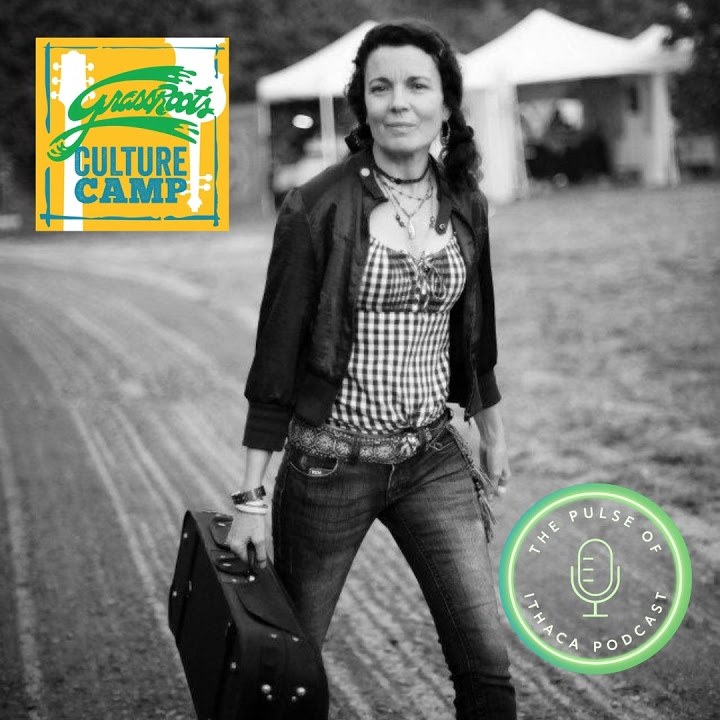
InterviewTara NevinsDonna the Buffalo
Interview: Tara Nevins, Donna the Buffalo Co-Founder
Recorded at GrassRoots headquarters in Trumansburg, the Donna the Buffalo co-founder walks through the camp's Miami origins, the 1990 benefit that became the festival, and the Louisiana parish hall that changed both.
by
May 23, 2025
TRUMANSBURG, N.Y. — Tara Nevins, a founding member of Donna the Buffalo and a co-founder of the Finger Lakes GrassRoots Festival, sat for a 46-minute interview with the Pulse of Ithaca Podcast recorded at the festival’s Trumansburg headquarters and published to the show’s YouTube channel on May 23, 2025.
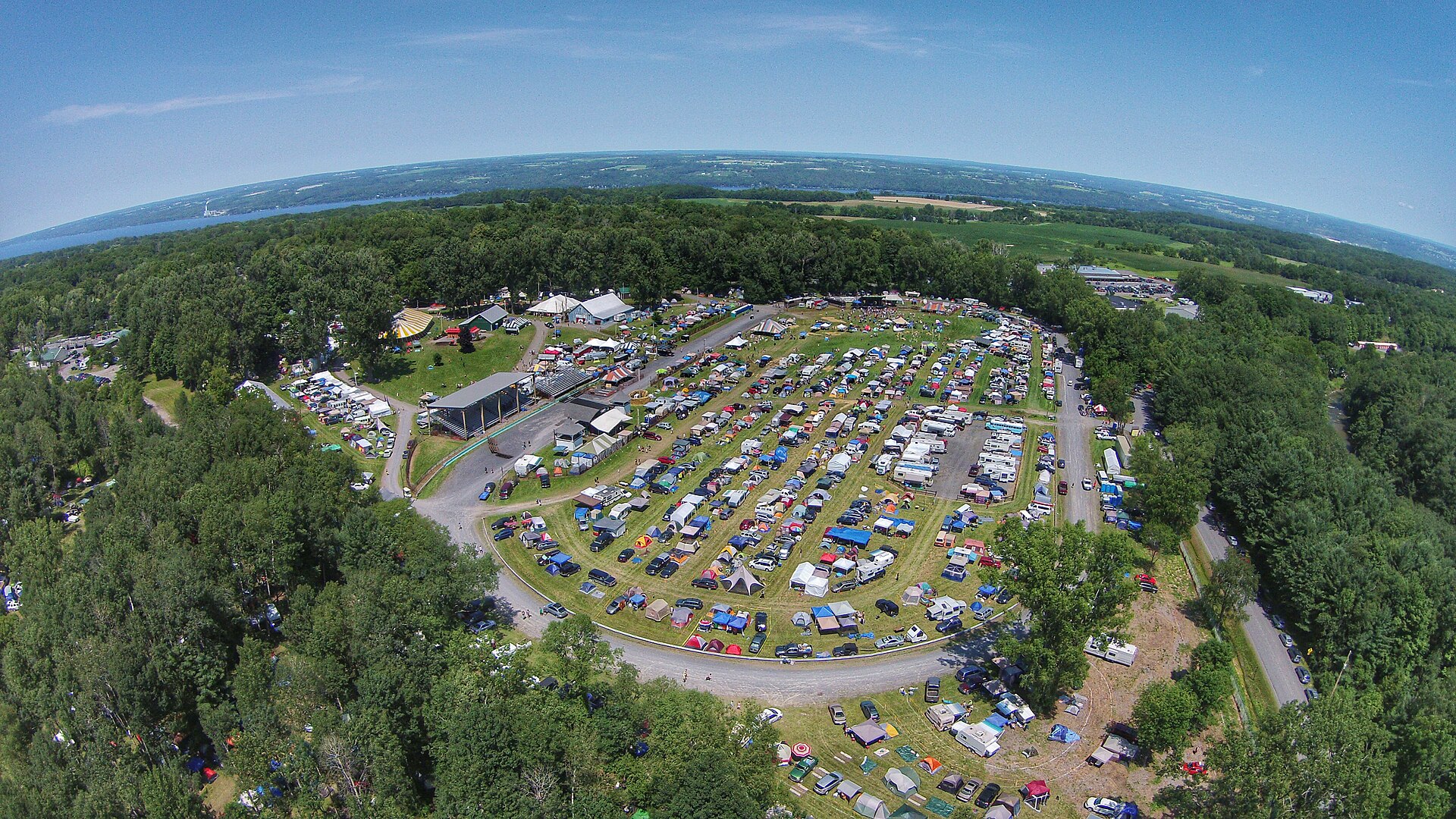
The occasion was the eighth GrassRoots Culture Camp, four days of workshops, themed dinners and nightly dances at the Trumansburg Fairgrounds running July 13 to 16, immediately before the 33rd Finger Lakes GrassRoots Festival on July 17 to 20. Nevins runs it, and she is candid that she did not think of it, was not especially interested in music camps, and inherited the job from a boy who was about eleven at the time.
The camp’s dinners and dances are open to the public without registering for the camp itself, and camping across the road from the fairgrounds returned for 2025. Registration and volunteer sign-ups run through grassrootsfest.org.
Fiddling in the back of the orchestra
Nevins grew up in Orangeburg, in Rockland County, and went to Tappan Zee High School. She played classical violin through school and into college at the Crane School of Music in Potsdam, and was pulled elsewhere the whole time.
The record she names as the turn is “Will the Circle Be Unbroken.”
“That really ignited my interest in traditional music,” she said. “Traditional fiddle music, bluegrass music, old-time music, all of that.”
"I just sort of started sitting in the back of the orchestra, in between the conductor talking while he was talking to the trumpets. I'd be back there sort of trying to fiddle away."
Tara Nevins
At Crane she fell in with a string band and roomed with its fiddle player, another violinist who shared the interest in fiddle music. Nevins graduated, left the classical track behind and started traveling to Southern fiddle conventions, Mount Airy in North Carolina and Galax in Virginia among them, which she still does.
“They’re just incredible times of just playing crazy music, crazy wild music, discovery,” she said.
She notes one coincidence with some amusement. Her college roommate’s older brother is Chris Broadwell, who owns Ithaca Guitar Works on North Cayuga Street, in the town Nevins never expected to end up near.
“Who ever thought that I’d end up in the Ithaca and Trumansburg area,” she said.
A live radio show, and a bar across the street
Nevins met Jeb Puryear through a broadcast. Her college string band had a gig on Bound for Glory, the live radio show at Cornell, and Puryear and his brothers heard it wherever they happened to be.
“They were driving around town looking for something to do, or just sitting around, whatever, the radio was on,” she said. They came to the show, arrived near the end, and came around backstage.
What happened next she treats as inevitable rather than notable.
“That’s what old-time musicians always do,” she said. “We go, okay, let’s jam now, let’s play some tunes.”
They went across the street to a Collegetown bar and played. Months later her band drove down again on the way to a Brandywine festival and took Puryear and some of his bandmates along. She moved to the area not long after.
“We just had such a connection musically, in every way,” she said.
A plate, a pair of chopsticks and a tape machine
Nevins was playing in an all-female string band called the Heartbeats when she and Puryear started writing together, and her account of Donna the Buffalo’s beginnings is domestic.
“Jeb had an old tape machine and we would sit and just for fun record these songs,” she said. “I would like get a plate and chopsticks and I would play the drums on the plate with the chopsticks, and Jeb would play the acoustic guitar and I would sing.”
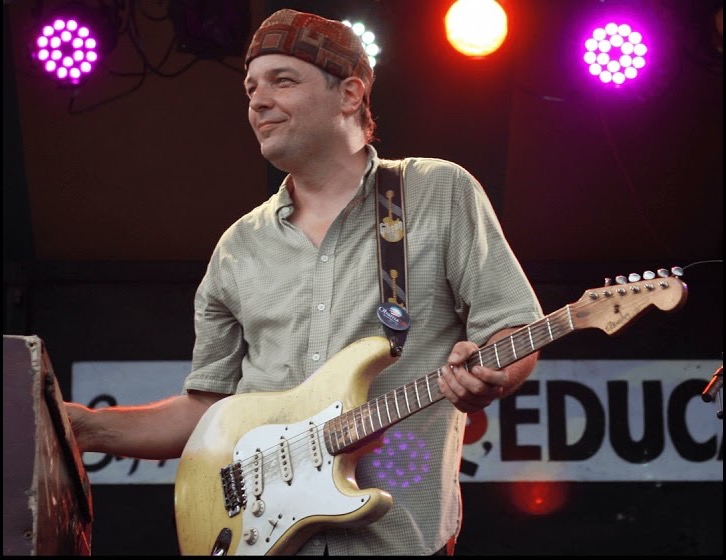
The band went electric by contagion rather than by decision. Puryear bought an electric guitar. Nevins got an electric fiddle, a pink one she says she still plays. Richie Stearns moved from fiddle tunes to organ and keyboards, a mandolin player from Puryear’s string band moved to a drum kit, and a guitarist from the same band picked up bass. For a stretch the band carried three songwriters.
“We just totally morphed,” she said. Asked whether they could have planned it, she was flat about it.
“No, we could never have planned it or organized it,” she said. “That’s the thing about Donna the Buffalo. We just always said we just do what we do and then it goes where it goes.”
One benefit at the State Theatre
The festival started as a single concert. Nevins and the others had spent years traveling to fiddle conventions and to listener-facing festivals, sneaking into some of them and busking outside others, and had accumulated opinions.
“We used to think, well, if we had a festival we would do it this way,” she said. “Why are they doing this here?”
In 1990 they staged a benefit concert at the State Theatre in downtown Ithaca and made it an AIDS benefit, a cause she says was chosen because it was immediate.
“We knew some folks in Ithaca who were affected,” she said. “It just seemed very relevant to the time.”
Nevins recalls the bill as The Horse Flies, Johnny Dowd and her own band, while saying the details had blurred. The room-height poster that hung outside the theatre still exists. The night worked, and Puryear asked the obvious next question.
“Jeb was like, well, why don’t we try doing a festival,” she said. “And we just thought, yeah, totally.”
The first festival was three days at the Trumansburg Fairgrounds, before it grew to four. The grandstand stage, the cabaret hall and an infield stage were there or were built. Radios were not.
“It completely rained the entire time,” she said. “It was a complete disaster, actually.”
The camp nobody at the table wanted to run
Culture Camp began at the organization’s Virginia Key GrassRoots Festival in Miami, and the idea came from a kid.
“Jonas, who at the time was probably around 12 years old, maybe 11, he really might have been 11, he must have been aware of these camps himself,” Nevins said. “He suggested to us, hey, why don’t we do one of those camps, and we were all like, really?”
They ran it in Miami for two years, and Nevins is direct that the setting did not fit the material.
“Miami is an amazing place and we love being there, but as far as Culture Camp, there’s such a strong Latin culture there, it is beautiful,” she said. “But it wasn’t really the place for Appalachian old-time fiddle music and banjos.”
They moved it to Trumansburg, where the fiddle players already were. The boy who proposed it grew up and moved on to other things, and the job landed with Nevins.
"It's just sort of this other hat I wear. It's just sort of easy for me to organize a bunch of stuff. I don't know why that is. I'm guessing I'm very obsessively detailed."
Tara Nevins
She is equally direct that she was never a camp person. “I taught at two,” she said. “I was never like big into the camps, really, and I know that sounds kind of funny.”
How the week is actually built
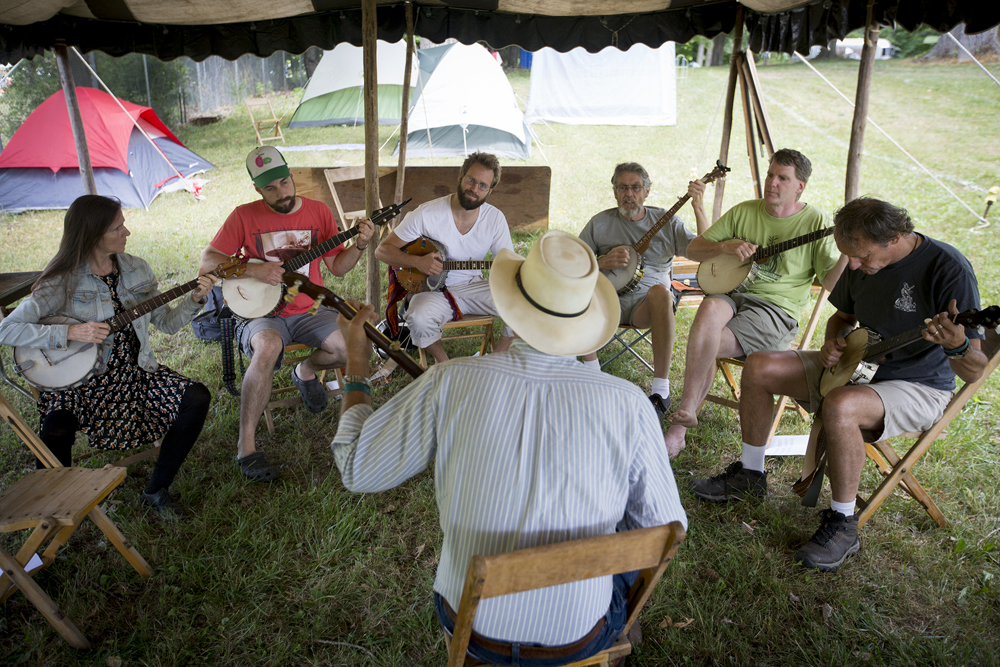
The camp runs workshops all day, then a themed dinner and a dance each night, with the food matched to the music: gumbo on the night of the zydeco dance, jambalaya on the night of the Cajun dance. Nevins said the camp brings in chefs from Louisiana where it can.
The dances drive everything else. Nevins books the nightly band first, then the workshops follow from whoever is in that band, because the players teach during the day.
“If you’re someone who wants to learn how to play Cajun fiddle, you’ll get to take a workshop with someone who is living in Louisiana,” she said. “You’re learning right from the source.”
For 2025 the Sunday honky tonk dance was Jim Lauderdale with his country band, a booking Nevins flagged as distinct from his festival appearances. Donna the Buffalo backs Lauderdale at GrassRoots every year.
“He’s never come here with his country band,” she said. “But they will not be at the festival, you see. So if you want to see Jim Lauderdale in this real country element with this band, you’ve got to come early.”
The rest of the week ran to a Cajun band from Lafayette, Louisiana, a New Orleans dance hall band, Preston Frank on the Wednesday zydeco dance, and The Byrne Brothers, a family band from Donegal, Ireland now based in Orlando, who also appeared on the festival’s own 33rd anniversary bill. Local instructors included Judy Hyman and Jeff Claus of The Horse Flies, the duo Richie and Rosie, and Maddy Walsh.
Nevins says the year’s New Orleans and jazz weighting was not a plan.
“It’s more like, when I start looking, the first thing I do is start looking for what are the bands going to be, what are the dances going to be at night,” she said. “And so all of a sudden you look at the whole picture and you go, wow.”
Asked whether a total beginner can attend, she said yes without qualification.
“You can be a beginner if you’ve never played an instrument but you really have an inkling that you would like to,” she said.
A parish hall in southwest Louisiana
The longest story Nevins tells is about the family that has played every GrassRoots since the first one. Before the festival existed, she and others were in southwest Louisiana around Mardi Gras and were told to drive out into the country to a small parish building.
“We went in the place and we were the only non-Creole people there and we definitely stood out,” she said. “The place was probably the size of this office. It was so tiny.”
The band was the Frank family. Nevins puts the drummer, Brad Frank, at nine years old, the bass player, Jennifer, at twelve or thirteen, and Keith Frank at about fifteen, with their father Preston leading. They bought the band’s 45 and went home.
When the festival came together, somebody remembered.
“We looked at each other and said, I wonder if that family would come up here,” she said. “We got their phone number somehow and we called them and they agreed to come up here, and it was pretty crazy because we didn’t know if they even ever traveled.”
Keith Frank went on to lead his own band out of Soileau, Louisiana with Brad on drums and Jennifer on bass. Preston Frank still teaches Creole accordion at the camp.
"The festival would not be the same without them. The zydeco music has just taken off, and it was just a result of this spontaneous trip and meeting these incredible musicians down there."
Tara Nevins
They also brought her a piece of equipment she has used since.
“They delivered me my very first scrub board,” she said.
Volunteering, and the argument for coming early
Asked what she would add, Nevins went to cost and to access. Culture Camp and the festival together make for a long and expensive week, and volunteering is a way through it.
“Everything’s outdoors over at the fairgrounds, like the kitchen is outside,” she said. “Everyone’s helping chop in the kitchen or helping up at the ticket booth, and it’s actually fun. You’re meeting people immediately that way.”
She notes that camp and festival volunteer sign-ups are separate items on the festival website. The other argument she makes for the camp is what it does to the festival that follows.
“When you come, you arrive at a festival and it’s just complete mayhem,” she said. “If you’re part of the camp for the four days before, you’re totally integrated. The next morning you’re at this festival and you have this whole new group of people.”
Some campers, she said, have stopped wanting the second part.
“People sometimes just prefer Culture Camp,” she said. “They’re like, I’d rather just do this.”
Watch the full episode on YouTube
The author co-hosts the Pulse of Ithaca Podcast and conducted this interview. Quotations are transcribed from the episode audio and lightly trimmed for filler. Speaker and band names have been corrected against the festival’s own instructor listings and other published sources where the automatic transcript garbled them, and several names spoken in the episode are omitted here because they could not be verified against a published source.
The 8th annual GrassRoots Culture Camp ran July 13 to 16, 2025 at the Trumansburg Fairgrounds in Trumansburg, New York, ahead of the 33rd Finger Lakes GrassRoots Festival of Music & Dance on July 17 to 20, 2025. Pulse of Ithaca Podcast, Episode 21, running 45 minutes and 57 seconds, recorded at GrassRoots headquarters in Trumansburg and published to the show’s YouTube channel on May 23, 2025.
Sources: Pulse of Ithaca Podcast, Episode 21, Pulse of Ithaca Podcast channel, GrassRoots Culture Camp instructor bios, Donna the Buffalo, Keith Frank, Johnny Dowd, Maddy Walsh bio, Ithaca Guitar Works listing, bandsthatjam.com, GrassRoots 2025 lineup.